










































METLZ – Metallic Resonator Instrument
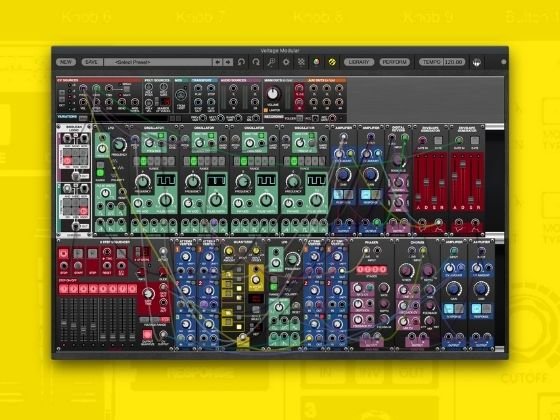
METLZ is a playable metallic percussion and resonator module for Voltage Modular. It is designed to cover a wide range of struck metal sounds, from bright small objects to large resonant bodies and evolving cascades. Instead of using sample playback, METLZ generates its sound from a bank of resonant modes combined with different excitation models, so each instrument type reacts differently in pitch, decay, stereo spread, impact, strike position and internal energy behavior. The result is a module that spans sharp triangle-like tones, bright crotales and glock colors, compact cowbell attack, tubular and handbell resonance, flatter plate textures, hard anvil and brake-drum strikes, unstable industrial metal, heavy church-bell weight, blooming gong washes and bell-tree cascades.
Main Concept
The TYPE control selects the metallic model. Each model has its own tuning compensation, tuning range, decay range, brightness behavior, stereo response and output scaling. This means the same settings do not behave identically for every type. A church bell remains heavier and longer than a handbell, a cowbell stays drier and more compact than a plate, and a gong responds with a broader, slower build than brighter small-metal models. METLZ is intended to behave as a family of related metallic instruments rather than as one oscillator with cosmetic changes. TYPE switches directly between models rather than morphing continuously.
Inputs and Outputs
PITCH is the main pitch control input. METLZ follows the incoming control voltage and uses it as the base pitch before the selected model applies its own register and tuning behavior.
TRIG starts a single strike.
TREE starts an internal cascade of multiple strikes, useful for bell-tree, wind-chime and clustered metallic behavior.
VEL controls strike strength. Higher velocity increases excitation energy and can make the sound brighter, stronger and more animated depending on the selected model.
OUT L and OUT R are the stereo audio outputs.
Assignable Mod Inputs
METLZ includes six freely assignable modulation inputs. Each MOD input has a selector button beneath it. Click that button to choose the target for that modulation input. Available targets are TYPE, EXC, TUNE, FINE, DEC, CHAR, HITX, HITY, IMPACT, WIDTH and LEVEL. The modulation depth is internally scaled per destination, so some targets react more strongly than others. HITX and HITY are especially effective for animated strike movement, while FINE can be used for gentle pitch drift or subtle detuning. Because the modulation system is target-based, the same patch can be quickly repurposed without changing cabling.
Type Models
TRIANGLE produces bright, metallic, high-frequency struck tones with a relatively compact decay and a clean upper spectrum.
CROTALES is very bright, high and focused, with a small-metal shimmering quality.
COWBELL is compact, dry and punchy, with a more closed metallic tone and a shorter, more defined body than bell-like models.
GLOCK is tighter and more bar-like, suitable for short pitched metal notes.
TUBULAR has a larger, more resonant bell-tube behavior with a lower and more sustained response.
HANDBELL is bell-like but smaller and more controlled than the church bell model.
BELLTREE is designed for clusters of small metallic hits, especially in combination with the TREE trigger.
PLATE has a flatter metallic resonance with a broader, more diffuse body.
ANVIL is hard, percussive and heavy with strong transients.
BRAKE emphasizes industrial circular metal tones with harsher inharmonic content.
INDUSTRIAL introduces strong inharmonicity, noise interaction and unstable behavior for more experimental sounds.
CHURCH produces large, heavy bell tones with long decay and slow evolution.
GONG creates wide, evolving metallic washes with strong beating, long resonances and a slower low-register bloom than the brighter models.
Exciter
The EXC control selects the excitation type used to strike the resonator. MALLET produces a soft, rounded attack. STICK gives a more defined transient. METAL introduces a harder, brighter impact. SOFT reduces the attack and emphasizes the resonant body. SCRAPE adds a noisier tail and more continuous excitation. The exciter strongly influences how the modes are energized and how the sound evolves over time.
Tone and Behavior Controls
TUNE adjusts pitch in semitone steps around the incoming PITCH signal. Each model defines its own effective range and base register, so identical settings can result in different perceived pitches depending on the selected TYPE.
FINE adds a smaller continuous pitch adjustment around the TUNE setting. This is intended for exact tuning against oscillators, small corrective offsets per model or subtle moving detune under modulation.
CHAR shapes the spectral behavior of the sound. Increasing CHAR generally introduces more brightness, inharmonicity and complexity.
IMPACT controls how strongly the exciter drives the resonator. Higher values increase energy, brightness and perceived attack.
DECAY controls how long the sound sustains. Each model maps this differently, allowing large objects to reach longer decay times while smaller ones remain shorter and tighter.
HIT X and HIT Y define the virtual strike position. Different positions excite different modal patterns, affecting both tone and stereo response.
WIDTH controls stereo spread. Some models respond more strongly than others depending on their structure.
LEVEL sets the final output level.
Tree Engine
The TREE system generates a sequence of internal strikes after a trigger. TreeSpd controls the spacing between hits. TreeCnt sets how many hits are generated. TreeRnd introduces randomness in timing, pitch, strike position and velocity. With low randomness the sequence behaves more predictably, while higher randomness produces looser and more chaotic metallic cascades. This makes it possible to create realistic bell trees, wind chimes and unstable clusters without external sequencing.
Gong Behavior
The GONG model includes a slower low-register response than the other models. At lower pitches the attack does not only strike and decay; it also develops a delayed bloom, so the body of the sound swells after the initial hit instead of behaving like a short bright transient. Higher-pitched gong settings remain more direct, while lower-pitched settings feel larger and heavier.
Canvas Interaction
The central canvas represents the strike surface of the current instrument. Clicking or dragging sets the strike position and can trigger a manual hit. The visual feedback shows energy, strike intensity and motion over time, allowing intuitive exploration of how different areas influence the sound.
Level Balancing
Each model includes internal output scaling to maintain more consistent perceived loudness across very different instrument types. Large resonant models such as GONG and CHURCH are controlled to prevent excessive output, while smaller or sharper models remain clear and present.
Usage Notes
Use TYPE to switch between different metallic instruments and explore contrasting behaviors.
Use TUNE for musical transposition and FINE for exact tuning or subtle detune movement.
Animate HIT X and HIT Y for evolving timbre and stereo motion.
Combine TREE with randomness for natural chime patterns and clustered metallic events.
Lower IMPACT for softer ambient textures and raise it for sharper percussive hits.
GONG works especially well at lower pitches when you want a slower swelling body instead of a direct bell-like response.
METLZ responds strongly to small parameter changes, so subtle adjustments can produce significant sonic differences.
No reviews yet. Be the first to review this product!
F_METLZ
$15.00 $18.00