










































F_MODZ — Macro Motion Modulator (Manual)
Overview
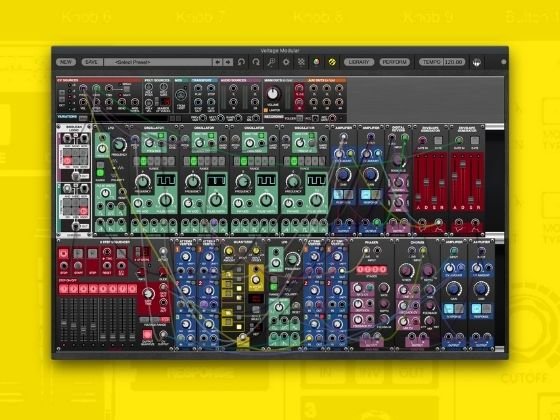
F_MODZ is a compact macro-controlled modulation engine designed for expressive movement inside Voltage Modular. Instead of offering a single simple LFO, F_MODZ blends multiple internal modulation layers into one evolving signal. At low MACRO settings it behaves like organic vibrato or subtle analog drift. As MACRO increases, the waveform becomes more complex, harmonically richer, and more aggressive. The module is intentionally performance-oriented: one large control dramatically reshapes the character of motion.
Signal Flow
The internal engine consists of several interacting LFO components running at related but slightly detuned ratios. These are combined in two different ways: a subtractive blend for smooth and beating-style motion, and a multiplicative blend for more complex, ring-like modulation. The BIAS control crossfades between these behaviors. The resulting waveform is shaped by SKEW, scaled by DEPTH, optionally delayed by GATE + DELAY, and finally sent to the output in either bipolar or unipolar mode.
Top Row — Inputs
MAC CV modulates the MACRO parameter. A +5V signal adds the equivalent of full knob travel. This input allows animated transitions from subtle movement to chaotic modulation.
RATE CV modulates the overall speed of the internal LFO structure. Positive voltage increases modulation speed.
MUL IN acts as a modulation VCA. The incoming signal is converted to a 0…1 range and multiplies the modulation depth. This is ideal for envelopes or other LFOs controlling how much motion is applied.
GATE enables delayed modulation entry. When a rising edge is detected, the module waits according to the DELAY setting before fading the modulation in. If no cable is connected, the delay system is bypassed and modulation is always active.
Main Control
MACRO is the central performance control. Low values produce smooth, slow, organic motion with subtle internal interaction. Mid values introduce complexity and layered movement. High values increase internal spread, add controlled chaos, and shift the waveform toward sharper and more animated behavior. The waveform display changes color as MACRO increases, transitioning visually from calm to intense.
Secondary Controls
RATE sets the base modulation speed. The response is curved for fine control at low speeds and wider range at higher settings.
DEPTH controls the overall amplitude of the modulation signal before output scaling.
SKEW reshapes the waveform asymmetrically. At center, the modulation is balanced. Turning SKEW shifts the waveform distribution, creating pulse-like, asymmetric, or leaning shapes depending on MACRO intensity.
BIAS determines how the internal LFO layers are combined. At lower settings the behavior is more subtractive and smooth. At higher settings the interaction becomes more multiplicative and complex, introducing sharper modulation textures. BIAS changes character rather than speed or depth.
DELAY sets the time between a detected GATE rising edge and the moment modulation begins. After the delay time has passed, modulation fades in smoothly to avoid clicks or abrupt jumps. When no GATE cable is connected, DELAY has no effect.
Output Modes
BIP (bipolar) outputs -5V to +5V. This mode is ideal for pitch, FM, or any destination where modulation should move around a central point without shifting it.
UNI (unipolar) outputs 0V to +5V using rectification. This mode is useful for controlling VCAs, filter amounts, or modulation depths. Unlike traditional unipolar offset implementations, this mode does not introduce a fixed DC offset that would unintentionally transpose oscillators.
Wave Display
The waveform display shows a full static cycle of the current modulation shape. It does not scroll or drift; it updates only when parameters change. The color intensity and thickness reflect MACRO intensity. The display represents the internal bipolar signal before final output scaling.
Typical Use Cases
Use F_MODZ in bipolar mode for pitch vibrato, FM, or oscillator phase modulation. Use unipolar mode for filter sweeps, VCA movement, or dynamic modulation depth. Combine GATE and DELAY to let notes start clean and introduce motion slightly after the attack phase. Patch an envelope into MUL IN to control how strongly motion is applied over time. Animate MACRO with another slow LFO for evolving modulation character.
Performance Philosophy
F_MODZ is not a precision laboratory LFO. It is a motion instrument. The MACRO control is meant to be played. At subtle settings it enhances realism. At extreme settings it becomes animated, unstable, and expressive. The design favors musical behavior over mathematical purity, allowing modulation to feel alive rather than static.
No reviews yet. Be the first to review this product!
F_MODZ
$10.00 $14.00