





































Manufacturer: Request For Music
$11.50 $15.00
F_RANDZ is a compact dual random CV generator with two fully independent channels (A and B). Each channel can create stepped random values, smoothed random values, or drifting “random walk” movement. You can clock it externally, or let it run on its internal clock. Optional quantizing makes it musical (chromatic or scale-based) and each channel has its own quantize + scale settings.
Signal Flow (per channel)
- CLK IN: External clock input. If a cable is connected here, the channel will advance on rising edges of CLK (gate > ~1V). If not connected, the channel uses its internal RATE clock.
- HOLD IN: Freeze input. When HOLD is high (gate > ~1V), the channel keeps outputting the current smoothed value and will not generate new targets on ticks.
- RST IN: Reset input. On a rising edge, the channel resets its internal phase and re-seeds its random generator from the SEED knob (so reset is repeatable per seed).
- SRC IN: Source input. If connected, the channel samples the SRC voltage on each tick (instead of generating a purely random value). This sampled value is then processed through RANGE and (optionally) QUANTIZE.
- OUT: Random CV output of the channel (clamped internally to -10V…+10V).
Controls (per channel)
- RATE: Internal clock speed in Hz. Only used when CLK IN is not connected. Higher values tick faster (more frequent updates).
- SLEW: Glide/smoothing time. At 0 ms the output jumps instantly to the new target. Higher values glide smoothly toward the target.
- PROB: Update probability on each tick (0…1). At 1.0 the channel updates every tick. At 0.5 it updates about half the time. At 0.0 it never updates (it will hold the current target).
- SEED: Random seed. This makes the random sequence deterministic. If you use the same seed and the same clock pattern, you get the same sequence again. Reset (RST) re-seeds from this knob.
- BIAS: Voltage offset added after range mapping. Useful to shift the whole output up or down.
- MIN / MAX: Custom range limits (only used when RANGE is set to CUSTOM). MIN can be higher than MAX; the module will internally treat the lower value as the minimum and the higher value as the maximum.
Switches (per channel, 3-state)
- MODE:
- STEPPED: Generates a new target value on each tick (when PROB allows it). Output may still glide if SLEW > 0.
- SMOOTH: Same update behavior as STEPPED, but typically used with higher RATE and/or higher SLEW for flowing motion. (Functionally it still uses the same glide system; the “smoothness” comes from your RATE/SLEW settings.)
- DRIFT: Random-walk mode. Instead of jumping to a new random target, the target slowly wanders in small steps. This creates organic, evolving movement.
- RANGE:
- UNI: Unipolar range (0…+5V) for generated random values. With SRC connected, the signal is passed (with bias) and clamped.
- BI: Bipolar range (-5…+5V) for generated random values. With SRC connected, the signal is passed (with bias) and clamped.
- CUSTOM: Uses MIN…MAX as the output range for generated values. With SRC connected, CUSTOM acts like a “constrain/scale” stage (values are limited into MIN…MAX).
- QUANT:
- OFF: No quantizing. Output is continuous voltage.
- CHR: Chromatic quantize in 1V/oct space (semitone steps = 1/12 V).
- SCALE: Quantize to a musical scale selected by the SCALE switch.
- SCALE (used when QUANT = SCALE):
- MAJOR: Major scale quantization.
- MINOR: Minor scale quantization.
- PENT: Major pentatonic quantization.
Typical Patches
- Classic stepped random: MODE = STEPPED, PROB = 1.0, SLEW = 0 ms. Patch OUT to filter cutoff or oscillator pitch (with QUANT = CHR or SCALE for musical pitch).
- Slow evolving modulation: MODE = DRIFT, SLEW = 200–1000 ms, RATE = 0.1–2 Hz. Patch OUT to wavetable position, reverb size, or FM amount.
- Humanized sequencing: Use an external clock in CLK IN, set PROB below 1.0 so not every step changes. Quantize to SCALE for melodic movement.
- Sample-and-process: Patch an LFO or envelope to SRC IN. Each tick samples SRC, then RANGE/BIAS and QUANT shape it into controlled, repeatable steps.
- Freeze moments: Patch a gate or manual button to HOLD IN to “pause” the random output at musical moments.
Notes & Tips
- External vs internal clock: If CLK IN is connected, RATE is ignored for that channel.
- Repeatability: To reproduce a sequence, keep the same SEED and use the same clock pattern (including resets).
- Quantizing pitches: For pitch, start with RANGE = BI (or CUSTOM around a smaller range), then QUANT = CHR or SCALE. Remember that 1V/oct pitch typically expects useful ranges like ~0…5V rather than the full -10…+10V span.
- MIN/MAX safety: In CUSTOM range, swapping MIN and MAX is fine; the module will still behave sensibly.
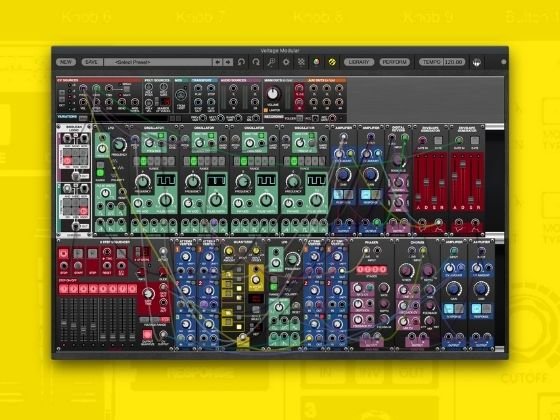
- Clamping: The output is internally clamped to -10V…+10V to stay safe in Voltage Modular patches.
No reviews yet. Be the first to review this product!