

















































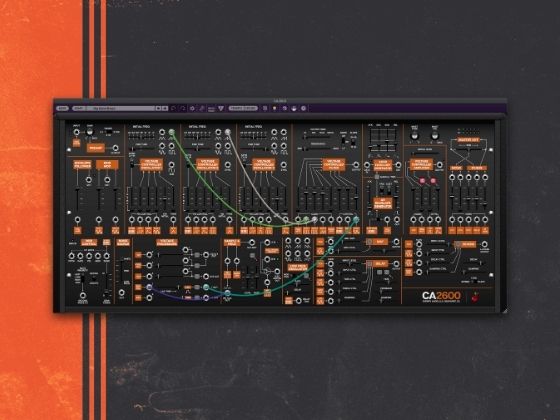





F_VCF30 – Voltage Controlled Filter (3 Algorithms)
F_VCF30 is a compact voltage-controlled lowpass filter module that offers three different ladder-style filter algorithms, a selectable pole count (1–5), and multiple cutoff modulation inputs. The filter is designed for musical resonance and classic analog-style behavior, but each mode has its own character and response.
Signal Flow
- Audio IN is the jack at the top-right (IN[2]). This is the only jack that feeds the audio signal into the filter.
- The audio signal is scaled by the INPUT knob, processed by the selected filter mode and pole setting, then scaled by the OUTPUT knob and sent to OUT (bottom jack).
- Cutoff Frequency is controlled by the CUTOFF knob plus up to three modulation sources (Timbre Mod, External, Envelope).
Controls
- CUTOFF (Hz): Sets the base cutoff frequency (0–15000 Hz). The final cutoff is clamped to a safe range; in some modes it will not go below 110 Hz.
- RESONANCE: Increases feedback around the filter. Higher values emphasize the cutoff region and can approach self-oscillation behavior depending on mode and pole setting.
- INPUT: Audio input gain for the audio jack (IN[2]). Use this to drive the filter harder or keep it clean.
- OUTPUT: Output level after filtering (0–2). Use this to compensate for resonance or input gain changes.
- TIMBRE MODULATION (bipolar): Amount of cutoff modulation coming from the Timbre Mod jack (IN[0]). Positive values push cutoff higher; negative values invert the modulation.
- ENVELOPE (bipolar): Amount of cutoff modulation coming from the Envelope jack (IN[3]). Positive values open the filter with the envelope; negative values invert the envelope direction.
- EXTERNAL (toggle): Enables/disables the External modulation input (IN[1]). When OFF, IN[1] has no effect.
- Pole (1–5): Selects the number of filter stages / the stage tap. Higher values create a steeper slope and a “deeper” filtering effect. In some modes, pole selection also affects resonance intensity.
- Filter Type (3-position switch): Selects the internal filter algorithm: Stilson, Krajeski, or Improved.
Jacks
- IN[2] Audio In (top-right): Main audio input to be filtered.
- IN[0] Timbre Mod (top-left): Cutoff modulation input scaled by the TIMBRE MODULATION knob. Intended for LFOs, random CV, or performance modulation.
- IN[1] External (top-middle): Cutoff modulation input that is only active when the EXTERNAL toggle is ON. This input is mapped in a musical/pitch-like way rather than a simple Hz offset.
- IN[3] Envelope (top): Cutoff modulation input scaled by the ENVELOPE knob. Intended for envelopes, gates converted to CV, or transient shaping.
- OUT (bottom): Filtered audio output.
Filter Types (Mode Switch)
- Mode 0 – Stilson: A classic ladder-style model with saturation and a gain-compensation table for resonance. Typically smooth and “Moog-like”, with a musical resonance curve.
- Mode 1 – Krajeski: A ladder-inspired model using nonlinear tanh shaping and a different internal structure. Often feels tighter and more “edgy” at high resonance, with a slightly different low-end response.
- Mode 2 – Improved: A more advanced virtual-analog style implementation using trapezoidal integration and nonlinear stages. Can get more aggressive and allows deeper cutoff clamping (cutoff can go down to 0 Hz).
Filter Algorithms – Detailed Explanation
F_VCF30 provides three different low-pass filter algorithms. Although all three are ladder-style designs and share the same front-panel controls, their internal behavior, non-linearities, resonance response and cutoff handling differ significantly. Selecting a different filter type is therefore not just a tonal variation, but a change in the underlying model.
Mode 0 – Stilson
The Stilson mode is based on a classic digital ladder filter approach inspired by the work of Stilson and Smith. It models a cascade of one-pole stages with nonlinear saturation and a frequency-dependent resonance compensation curve.
This mode is well suited for classic subtractive synthesis, warm sweeps, bass filtering, and expressive envelope-driven cutoff modulation.
Mode 1 – Krajeski
The Krajeski mode is another ladder-inspired filter, but with a different numerical structure and nonlinear treatment. It uses a chain of state variables with explicit nonlinear shaping at the input stage and resonance feedback that depends on the cutoff frequency.
Instead of relying on a static gain table, resonance is dynamically scaled as a function of the normalized cutoff frequency. This results in a resonance response that can feel tighter and more forward, especially at mid to high cutoff values.
The pole control selects which internal stage is used as the output, effectively changing both slope and phase response. Compared to Stilson mode, Krajeski mode often sounds slightly more aggressive and defined, with a firmer low-end and a more pronounced resonance bite.
As with Stilson mode, the cutoff frequency is prevented from going below a minimum threshold to maintain numerical stability and predictable resonance behavior.
Mode 2 – Improved
The Improved mode uses a more advanced virtual-analog ladder structure based on trapezoidal (TPT-style) integration and nonlinear stage processing. Each stage is integrated per sample and passed through a nonlinear transfer function, closely approximating continuous-time behavior.
Unlike the other modes, resonance in Improved mode is directly scaled by the selected pole count, meaning that increasing the number of poles also increases the internal feedback intensity. This makes the interaction between pole selection and resonance more pronounced and expressive.
The output is taken from a selectable stage in the ladder, allowing pole selection to directly influence both the slope and the harmonic character of the filter. In this mode, the cutoff frequency is allowed to reach down to 0 Hz, enabling complete signal attenuation and very deep filter closures.
Improved mode is capable of sharper resonance, stronger nonlinear behavior and more extreme filtering effects. It is especially suitable for sound design, aggressive modulation, and experimental patches.
Summary of Algorithm Differences
- Stilson: Smooth, compensated resonance, classic ladder character, warm and stable.
- Krajeski: Tighter response, dynamic resonance behavior, slightly more edge.
- Improved: Most nonlinear and expressive, deeper cutoff range, strongest interaction between poles and resonance.
Because the three algorithms respond differently to cutoff, resonance, pole selection and modulation depth, the same control settings can yield noticeably different results between modes. Users are encouraged to treat the Filter Type switch as a core sound-shaping control rather than a subtle variation.
Important Behavioral Notes
- Cutoff minimum differs by mode: In Stilson and Krajeski modes, cutoff will not go below ~110 Hz. In Improved mode, it can go down to 0 Hz.
- Pole affects more than slope: Pole selection changes which internal stage is used as the output. In Improved mode it also scales resonance internally, so higher pole values can feel more intense.
- External input mapping: The External jack (IN[1]) is mapped using a pitch-to-frequency style conversion, which can feel very musical but is not a simple “Hz offset”.
Quick Usage Tips
- For classic warm sweeps: start with Stilson, Pole 4, moderate resonance, and use an envelope into the Envelope jack with ENVELOPE set positive.
- For punchy resonant effects: try Krajeski with higher resonance and Pole 3–5.
- For extreme filtering and deep closing: use Improved and sweep cutoff down; combine with negative envelope modulation for inverse sweeps.
No reviews yet. Be the first to review this product!