

















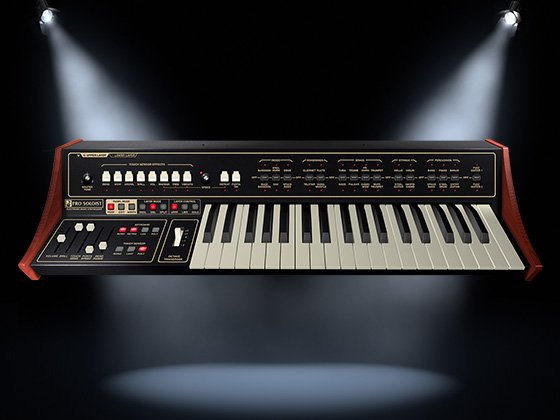



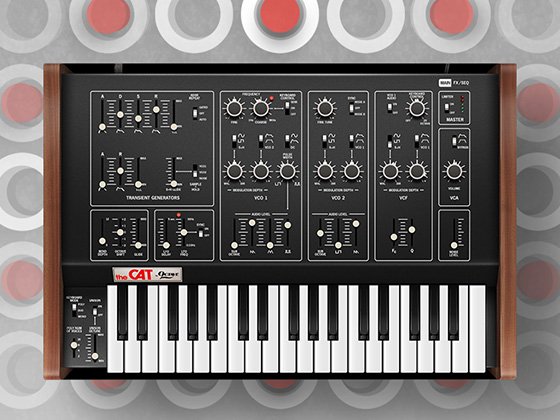






















Kritter
Monophonic synthesizer · one voice · Vulpus Labs
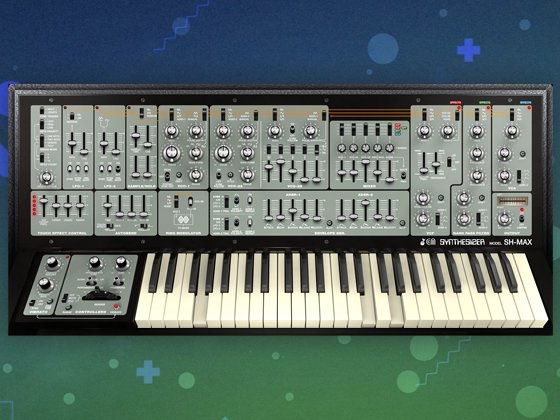
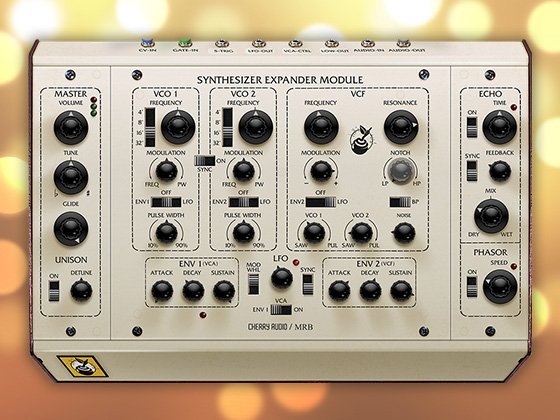
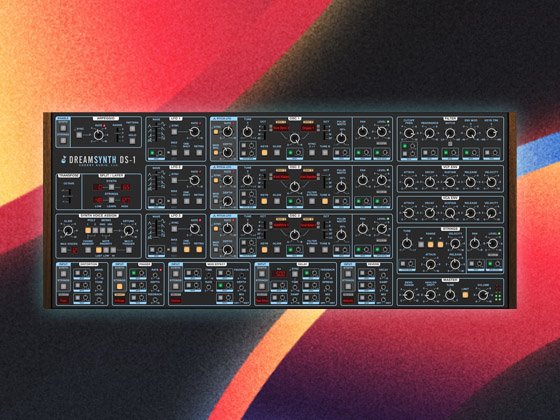
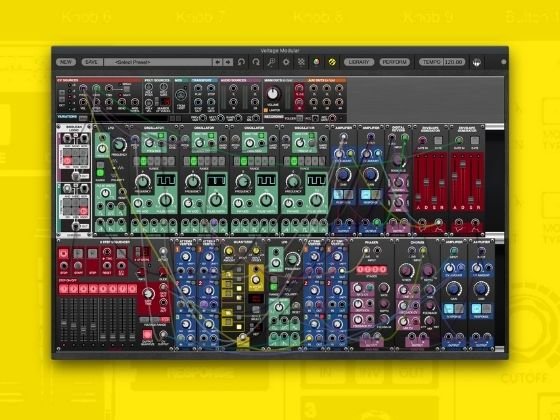
Kritter is a whole 70s-style monosynth in one module: a divider oscillator with five footages, a second oscillator, a ring modulator, two kinds of noise, the filter (a high-pass and a low-pass filter on two sliders side by side), a two-slider envelope, and a set of control switches — vibrato, delay vibrato, Repeat, portamento and the Bender. It is one voice, kept whole, in the instrument's signal order from left to right.
Patch a pitch into PITCH and a gate into GATE, take OUT to your mixer, and you have the instrument's raw sound: one sawtooth at 8', the filters wide open, an organ's envelope. The rest is shaping.
VCO 1
The front-panel oscillator: one oscillator running into a chain of dividers, which is why its five footages are always exactly in tune with one another.
SCALE (32', 16', 8', 4', 2') — the footage, in five detents, 2' at the top. 8' plays the pitch at PITCH; each step is an octave. It rests at 8'.
SCALE also moves the filter: both filters' range follows the footage, an octave of cutoff for each octave of SCALE. So a slider setting that sounds right at 8' sounds the same, an octave down, at 16'. The filters do not follow the key you play, only this switch.
WAVE (TRI, SQR, SAW, CH I, CH II) — the waveform, in five detents. It rests at SAW.
| detent | what it is |
|---|---|
| TRI | triangle. Soft, few harmonics. |
| SQR | square. Hollow, odd harmonics. |
| SAW | sawtooth. Bright and full; the instrument's default. |
| CH I | a pulse whose width is swept slowly, about 0.8 Hz, between 15% and 85%: a slow, rotating thickening. |
| CH II | the same pulse swept fast, about 5 Hz, and shallower, between 40% and 60%: a rotating-speaker shimmer. |
The two chorus settings are pulse-width modulation from their own oscillator, not from the vibrato section.
PITCH — the pitch input, 1 V/oct, 0 V at C2 with SCALE at 8'. It is the keyboard. Tracking is exact; there is no trim to set.
GATE — the gate input. Anything above 0 V is a key held down. A rise is a new note: it starts the envelope, the Bender's swoop, delay vibrato's fade and Repeat's clock. A gate that stays high while PITCH changes is a legato note, and nothing restarts.
CV — VCO 1's own pitch, added after SCALE, through the amount knob above the jack. The knob rests at its centre, where the CV does nothing; at either end it is the full 1 V/oct, and below the centre it is inverted, so a quarter turn is a quarter of an octave per volt. The tooltip gives the figure. It moves VCO 1 only: VCO 2, the ring modulator's carrier and the filter stay where they are. Patch an LFO here and play Duet for a slow beating against VCO 2, or a fixed offset to detune the two.
EFFECT
A second oscillator, the ring modulator and the noise, chosen by one six-way selector and mixed against VCO 1 by BALANCE.
By default, this whole section is silent in the mix.. To hear anything here, raise BALANCE.
SELECT — what the section sends to BALANCE, in six detents. It rests at DUET.
The three ring-modulator detents are marked LO, HI and FIX on the face, under one RING set on its side beside them; here they are RING LO, RING HI and RING FIX.
| detent | what it sends |
|---|---|
| DUET | VCO 2 on its own, following the key. A second oscillator. |
| RING LO | VCO 1 ring-modulated by VCO 2, VCO 2 following the key at DUET's pitch. |
| RING HI | the same, with VCO 2 two octaves above DUET's pitch. |
| RING FIX | VCO 1 ring-modulated by VCO 2 off the keyboard: a fixed carrier. |
| NOISE ♩ | pitched noise: noise ring-modulated by VCO 2 on the key, two octaves up as at RING HI: a noise with a pitch. |
| NOISE ∞ | white noise, for the filter to shape. |
The selector switches with no crossfade. Moved under a held note, it clicks, as a rotary switch does.
The ring modulator is a polarity switch: VCO 2, clipped into a rounded square, flips the sign of the input at its own rate. The input is multiplied by the square, and neither the input's pitch nor the carrier's is left in the output; what you hear is their sums and differences. With VCO 2 following the key (RING LO and RING HI) the result stays in the same relation to every note and plays in tune as a new timbre. VCO 2's own waveform does not matter here: only where it crosses zero does.
RING FIX is the odd one. VCO 2 stops following the key and sits at a fixed pitch, while VCO 1 still plays. Every key then gives a different, unrelated set of sums and differences: bells, gongs and clangs, with a "scale" that is no scale at all. The fixed carrier is set by the VCO 2 fader and FINE, from about A2 (110 Hz) at ×1 to A4 (440 Hz) at ×4. Sweep the fader under a held note for the classic ring-mod sweep.
BALANCE (0 to 10) — a straight crossfade between VCO 1 and the section. 0 is VCO 1 alone, 10 is the section alone, and 5 is an even mix. It rests at 0. In DUET this is the level of the second oscillator; in the modulator settings it is how much of the plain VCO 1 is left under the ring modulation.
VCO 2 (×1 to ×4) — VCO 2's pitch against VCO 1's 8', continuously, up to two octaves. The fader is marked in frequency ratios, because it is linear in frequency: the octave (×2) falls a third of the way up, and the twelfth (×3) two thirds. Anything between is a free interval — parallel thirds and fifths are there by ear. It rests at ×1, unison.
VCO 2 has no footage of its own. It always counts from VCO 1's 8', whatever SCALE says, so at 16' the two are an octave apart even with this fader at ×1.
FINE (−50 to +50) — VCO 2's fine tuning, in cents. It rests at the centre, exactly in tune.
FREE, JUST, EQUAL — How the VCO 2 fader is read. One is down at a time. FREE is continuous, so an exact interval is found by ear. JUST snaps it to the nearest beat-free interval: unison, the thirds, fourth, fifth, sixths and sevenths in whole-number ratios (5/4, 3/2, 5/3 …), the octave, the same again an octave up, and ×4. They are the intervals that sit still against VCO 1, and ×2, ×3 and ×4 are what make the ring modulator's sidebands harmonic. EQUAL snaps it to the nearest semitone, in tune with the keyboard; a fifth there beats slowly against VCO 1, as on any equal-tempered instrument. FINE detunes from wherever the fader lands, in all three. The fader's tooltip names the interval it is on, and how far off it is under FREE. It rests on FREE.
At unison the two oscillators are the same wave, sample for sample, so DUET at ×1 with FINE centred and VCO 1 on SAW sounds the same wherever BALANCE is. Turn FINE a few cents off centre for the slow beating of two oscillators.
EFFECT (ON / OFF) — the section's master switch. Off, the module plays VCO 1 alone wherever BALANCE is, so the section can be set up and then switched in and out in one move. It does not touch LONG or CUTOFF.
FILTER
A 12 dB/oct high-pass and a 12 dB/oct low-pass, in that order, each on its own slider, side by side. Between them they pass a band. Move the two sliders together and the band travels; move them apart and it widens; bring them together and it narrows to a single nasal peak.
HIGH PASS and LOW PASS (0 to 10) — the two cutoffs. Each mark is an octave, from about 20 Hz at 0 to about 20 kHz at 10, with SCALE at 8'. They rest at HIGH PASS 0, LOW PASS 10: the filter wide open, which is the instrument's setting.
Each filter is a diode ring, and like any diode filter it rounds off a loud signal a little rather than clipping it. The cutoffs do not follow the key; they follow SCALE (see VCO 1).
STOP (ON / OFF) — models a mechanical stop between the two knobs. On, the low-pass cannot go below the high-pass: push LOW PASS under HIGH PASS and it stays at HIGH PASS, as a knob would sit against the other. That holds for each slider and its CV taken together. ENV, CUTOFF and SCALE then move both cutoffs by the same amount, so they cannot break it. It rests ON.
Off is an addition. The two sliders are free, and the low-pass can be taken below the high-pass. The pass band then closes: the two slopes overlap, the level falls, and the sound thins to a hollow, quiet remainder of the overlap.
RESO (OFF to ON) — resonance: both filters ring at their cutoffs, the low-pass for about five cycles and the high-pass for about four. It lifts the harmonics near the cutoffs without raising the level of the passband.
ENV (OFF to ON) — the envelope on both cutoffs: how far each note's envelope moves the filter. Each note opens the band upward as the envelope rises and lets it fall back as it decays, so the same ATTACK and DECAY that shape the loudness shape the tone. It rests at OFF.
HP CV, LP CV —A CV on each slider, through the amount knob above its jack: off at the centre, where the knobs rest, and at either end one volt moves the cutoff one mark, inverted below the centre. Each adds to its slider's position, and the two together go no further than the slider can.
Vibrato on the cutoffs, which moves both with the vibrato oscillator, has its switch, CUTOFF, in the VIBRATO section, because it takes its speed and depth from there.
ENVELOPE
The envelope has two sliders, not four, and is not an ADSR. There is no sustain level. While the key is down the envelope rises to its peak, then either holds there or decays towards silence, or something between. When the key comes up it falls: almost at once, or slowly with SUSTAIN on.
The same envelope drives the amplifier and, through the filter's ENV knob, the filter.
ATTACK (FAST to SLOW) — the rise, from about 2 ms at FAST, which reads as struck, to about a second at SLOW. The rise is a capacitor charging: quick at first, easing into the peak.
DECAY (SHORT to HOLD) — what a held note does after the attack. At HOLD it stays at the peak for as long as the key is down, as an organ does. Towards SHORT it dies away while the key is still held, ending in a struck sound — a plucked string, a wooden bar — that is gone in under a second at the foot. It rests at HOLD.
SUSTAIN (ON / OFF) — the release, and only the release. Off, a note stops when the key comes up, in about 10 ms: fast, but not a click. On, it rings on after the key, for about a second and a half. The time is fixed; there is no slider for it.
LONG (ON / OFF) — makes the attack, the held decay and the SUSTAIN release eleven times as long: an eleven-second swell at SLOW, or a bell's tail of a dozen seconds and more with SUSTAIN on. It leaves the short release alone, so a note without SUSTAIN still stops with the key.
A new note starts its attack from wherever the envelope is, as a capacitor that has not finished discharging does. So a note struck in another's release does not drop to silence first. A legato note — the gate staying high while the pitch changes — does not restart the envelope.
ENV — The envelope as a CV, 0 to +5 V: the same curve the amplifier and the filter are given, Repeat's re-strikes included.
OUT — the audio output, about ±5 V at full level. It is at the far right of the face, under GLIDE, but it leaves from here: the amplifier is the last stage. The amplifier is linear in the envelope and closes just before the envelope reaches zero, so a note fades to true silence rather than leaking on.
VIBRATO
The vibrato oscillator, a triangle, and three switches that send it to the pitch or to the filter.
SPEED (SLOW to FAST) — the rate, from about 2 Hz to about 15 Hz. The centre, about 5.5 Hz, is a natural vibrato.
DEPTH (0 to 10) — how far, for both the vibrato and CUTOFF. The slider is weighted towards the bottom, so the centre is a tenth of the full depth. The top half is for effects.
VIBRATO (ON / OFF) — vibrato on the pitch from the start of each note.
DELAY (ON / OFF) — delay vibrato: vibrato that fades in after each new note, over about 0.6 s. The fade climbs only while the key is held, and a legato note does not restart it. With both VIBRATO and DELAY on, VIBRATO wins: full depth from the start.
Vibrato is a fixed swing in hertz, not in pitch, so it is deeper on low notes than on high ones. At the centre of DEPTH it is about ±25 cents around F♯3, about ±70 cents at C2 and under ±10 at C5. See Hertz, not pitch, below.
CUTOFF (ON / OFF) — vibrato on the filter, the instrument's travel vibrato: the vibrato oscillator on both filter cutoffs, so the band sways back and forth at SPEED. At the centre of DEPTH it swings a little under half an octave each way. It works on its own, without VIBRATO or DELAY, is never delayed, and is not switched off by EFFECT. It rests OFF.
LFO — The vibrato oscillator's triangle, ±5 V, before DEPTH. It runs all the time, whatever the switches say, at SPEED. Patch it into HP CV with STOP on, for example, to move only the bottom of the band.
REPEAT
A clock that strikes the held note again and again, for flutter, trill and mandolin effects.
SPEED (SLOW to FAST) — the rate, from about 2 to about 25 strikes a second.
REPEAT (ON / OFF) — while a key is held, the note is re-struck at SPEED. Each period, the envelope's gate is open for the first half and closed for the second, so each strike is a fresh attack and each gap is a release. The first repeat comes one period after the key, and a new key restarts the count. With the key up, or the switch off, nothing happens.
Repeat works through the envelope, so the envelope decides how it sounds. With ATTACK at FAST and SUSTAIN off, each strike is sharp and each gap is silent: a mandolin. With SUSTAIN on, the gaps fill in and the strikes become a pulse on a held note. With a slow ATTACK and a fast SPEED, the envelope never gets far before the next strike, and the note flutters.
SYNC — Pins Repeat to the host's tempo. With the button lit, SPEED no longer sets a rate: it picks a note value, from four bars at the bottom to a thirty-second triplet at the top, and Repeat strikes once per note value at the current tempo, following it if it changes. A new key still restarts the count, so the strikes fall on the beat when the key does.
RATE — A CV on SPEED, 1 V/oct: one volt doubles the rate. With SYNC on it doubles the note value's rate, so whole volts stay on the beat.
CLOCK — Repeat's clock, a square wave of 0 and +5 V at SPEED. It runs whether REPEAT is on or off and between notes, and a new key restarts it, so whatever it drives lands on the note's strikes.
GLIDE
TIME (SHORT to LONG) — how long PORTAMENTO takes. At the foot there is no glide at all; at the top a glide takes about six seconds to arrive. The slider is weighted towards the bottom, and its centre is a plain glide of a fraction of a second.
PORTAMENTO (ON / OFF) — each new pitch is reached by gliding from the last, at TIME.
The glide is in hertz, not in pitch. It covers the same fraction of the frequency gap in the same time, so rising and falling glides are not mirror images: a glide up an octave covers seven semitones in the time a glide down an octave covers five. A rising glide does most of its moving early and creeps in at the end; a falling one spreads its movement more evenly.
BENDER (ON / OFF) — a swoop into every new note: each one starts below its pitch and rises into it in about a quarter of a second, a slur rather than a siren. The swoop is a fixed distance in hertz, so it is about six semitones on a low C2, two around F♯3 and under one from C5 up. With PORTAMENTO on as well, the swoop is glided too.
Hertz, not pitch
The oscillators are linear in frequency, with a keyboard voltage that stands for hertz rather than for octaves. The vibrato, Bender, and portamento work on that voltage, so they work in hertz. A fixed swing in hertz is a wide swing in pitch on a low note and a narrow one on a high note, and a glide in hertz is lopsided.
Kritter takes a modular pitch, 1 V/oct, so that it plays with the rest of the rack. It turns that into hertz, applies the Bender, then portamento, then vibrato, and turns the result back into 1 V/oct for the oscillators. With all three off, PITCH passes through exactly, and the module tracks as any oscillator does.
What changes is only how the three sound across the keyboard:
- Vibrato at one DEPTH is deeper in the bass. Set it on the notes you mean to play.
- The Bender's swoop is wide on low notes and slight on high ones.
- Portamento rushes upward and eases downward.
For a vibrato equal in pitch across the keyboard, take LFO through an attenuator into VCO 1's CV; it moves VCO 1 only.
No reviews yet. Be the first to review this product!
Kritter
$15.00