










































RKW-1 - ZX Spectrum Beeper Emulator Module
Overview
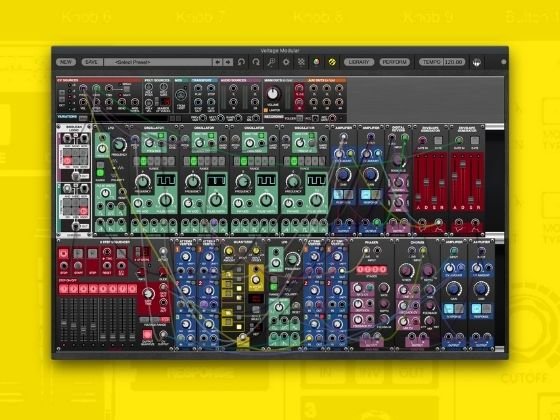
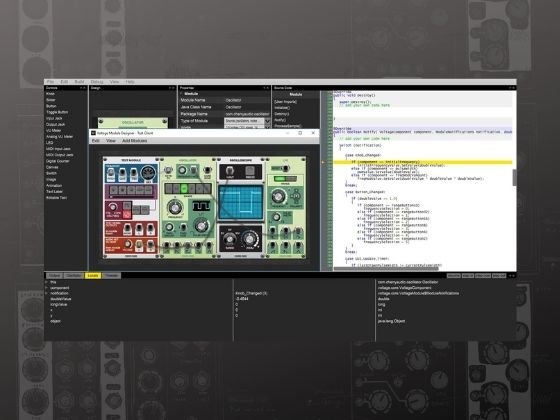
RKW-1 is a Voltage Modular module that emulates the iconic sound of the ZX Spectrum's piezo beeper. It accurately recreates the timing behavior, multi-channel mixing modes, and sonic character of the Spectrum's 1-bit audio output system.
What is the ZX Spectrum Beeper?
The ZX Spectrum (1982-1992) was a British home computer that used a simple piezo beeper for audio output. Unlike chip-tune synthesizers with dedicated sound hardware, the Spectrum's beeper was controlled directly by the CPU:
- 1-bit output: The beeper could only be ON or OFF (no volume control)
- CPU timing: Sound generation competed with program execution for CPU cycles
- Creative limitations: These constraints led to innovative multi-channel techniques
This module emulates both the technical behavior of the beeper hardware and the characteristic sound of how it was heard in the real world.
Module Interface
Inputs (4 Channels)
The module provides 3 identical voice channels and one noise channel. Each voice channel has three inputs:
V/Oct In (1-4)
- Standard 1V/octave pitch control
- Frequency range: ~65Hz (C2) to audible spectrum
- Defaults to C2 when nothing connected
Gate In (1-4)
- Enables/disables the channel
- High (>0V) = channel active
- Low (≤0V) = channel silent
Pulse Width In (1-3)
- Controls the duty cycle of the square wave
- Range: CV input scaled to 16-bit internal resolution
- Default: 50% duty cycle (0x7FFF)
- Affects timbre and perceived brightness
The noise channel has V/Oct In and Gate In inputs, but no pulse width control.
Output
Audio Out
- Single mono output
- Filtered through selectable acoustic profile (BP for piezo beeper, TV for television speaker)
Spectrum Timing Emulation
The module accurately emulates the ZX Spectrum's CPU-synchronized audio timing:
Frame Sync
- PAL: 50Hz (20ms per frame) - standard European Spectrum
- NTSC: 60Hz (16.67ms per frame) - rare NTSC models
- Sound parameters update once per frame, matching original hardware behavior
Tick Length
- Measured in Z80 CPU cycles
- Default: 50 cycles (~14.3μs @ 3.5MHz)
- Controls the time resolution of audio updates (i.e. beeper on/off)
Audio Budget
- Percentage of CPU time allocated to audio (0-100%)
- Simulates the trade-off between sound quality and program execution when playing in-game music
Phase Reset
- When enabled: All channels reset to phase 0 at each frame sync
- When disabled: Phases run continuously (more musical)
Mix Modes
The module offers four mixing strategies that replicate real ZX Spectrum techniques:
XOR (Exclusive OR)
Output = Ch0 ⊕ Ch1 ⊕ Ch2 ⊕ Ch3- Classic beeper technique used in many games
- Creates complex waveforms through phase cancellation
- Produces sum/difference frequencies
- Can create unexpected harmonic content and metallic tones
OR (Logical OR)
Output = Ch0 | Ch1 | Ch2 | Ch3- Output is HIGH if any channel is HIGH
- Simpler mixing, less timbral variety
- More "on/off" character than XOR
INTERLEAVE
One active channel per frame, rotating- Plays one channel at a time
- Cycles through active channels each frame
- Simulates time-slicing multiple sounds
- Creates rapid switching between tones
- Used in games to simulate polyphony
QUAD (Independent Mix)
Output = sum of all channels (0V to 5V). Simulates having one ZX Spectrum per channel- Each channel contributes 0V or 1.25V
- Simple additive mixing
- Most "modern" sounding
- Less authentic but more predictable
- Useful for layering
Filter Profiles
The module provides two acoustic profiles that shape the 1-bit square wave output:
PIEZO (Default)
Emulates the direct piezo beeper sound
- High-pass @ 300Hz: Removes sub-bass rumble that the tiny piezo element couldn't reproduce
- Peak @ 2500Hz (Q=1.5, +6dB): Strong resonant "beep" character from the piezo cone's physical resonance
- Low-pass @ 5000Hz: Simulates the physical bandwidth limitations of the small piezo element
TV_SPEAKER
Emulates a 1980s TV speaker reproduction
- High-pass @ 200Hz: Gentle bass roll-off typical of small TV speakers
- Peak @ 800Hz (Q=1.0, +3dB): Cabinet/cone resonance in the lower midrange
- Low-pass @ 8000Hz: Limited treble extension characteristic of period TV speakers
Credits
The ZX Spectrum was designed by Sir Clive Sinclair and his team at Sinclair Research Ltd. This module is a loving tribute to the creativity of Spectrum programmers who pushed 1-bit audio to incredible heights. (Although the most incredible were reached using still other techniques, to be explored in a future module...)
No reviews yet. Be the first to review this product!
RKW-1
$10.00